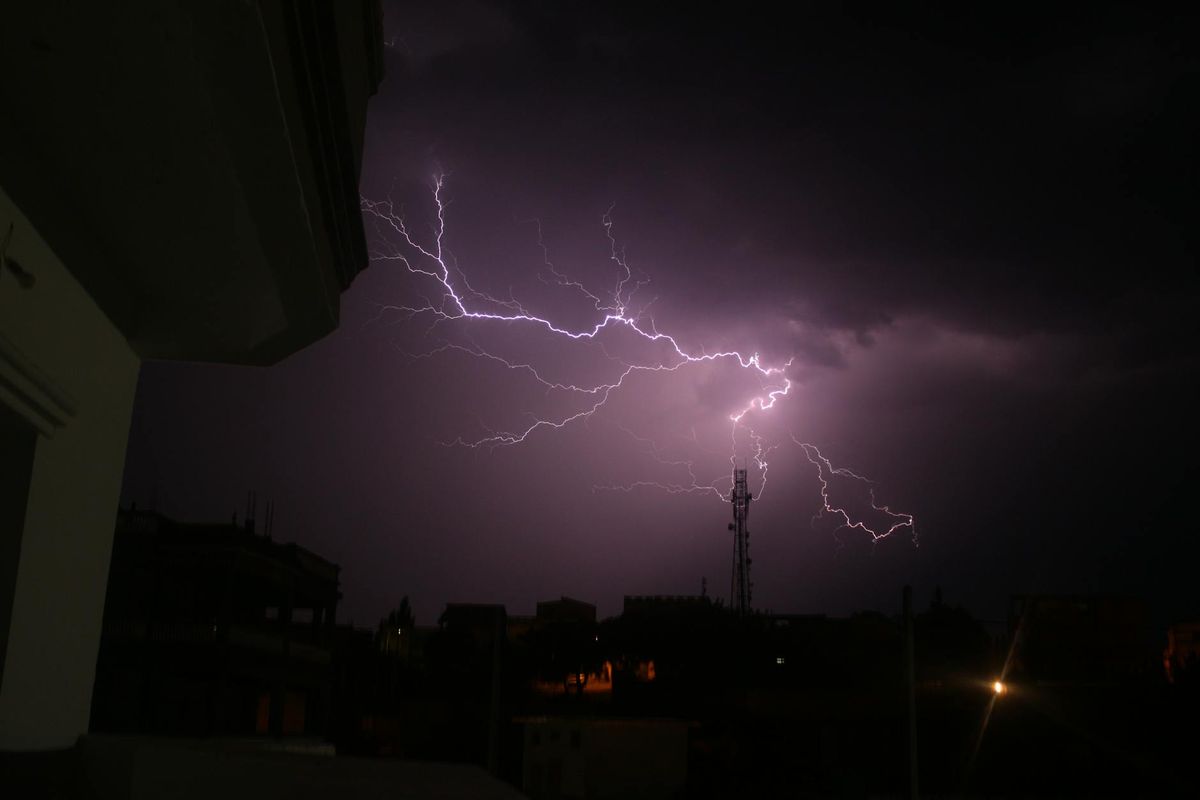
The vaporized silicon hypothesis, proposed by New Zealand chemists John Abrahamson and James Dinniss in 2000, has become one of the most widely cited and experimentally supported theories for ball lightning. The model proposes that when lightning strikes the ground, the extreme energy vaporizes silica (silicon dioxide) in the soil, reducing it to pure silicon vapor and nanoparticles. These silicon nanoparticles are ejected into the air and slowly re-oxidize upon contact with atmospheric oxygen, glowing as they burn — much like iron filings sparkle when thrown into a flame.
The collective glow of billions of burning nanoparticles, held together by charge and convection effects, would appear as a luminous sphere. The hypothesis was dramatically supported by the 2014 Chinese measurement of natural ball lightning, which detected silicon, iron, and calcium in the spectrum — precisely the elements predicted by the vaporized soil model. Laboratory experiments by Brazilian researchers in 2007 created silicon-based luminous balls by electrically vaporizing silicon wafers, producing objects that closely resembled small ball lightning.
The model's main limitation is that it predicts ball lightning should only form at or near ground level where lightning strikes soil, whereas some reports describe ball lightning forming in mid-air or at high altitude.