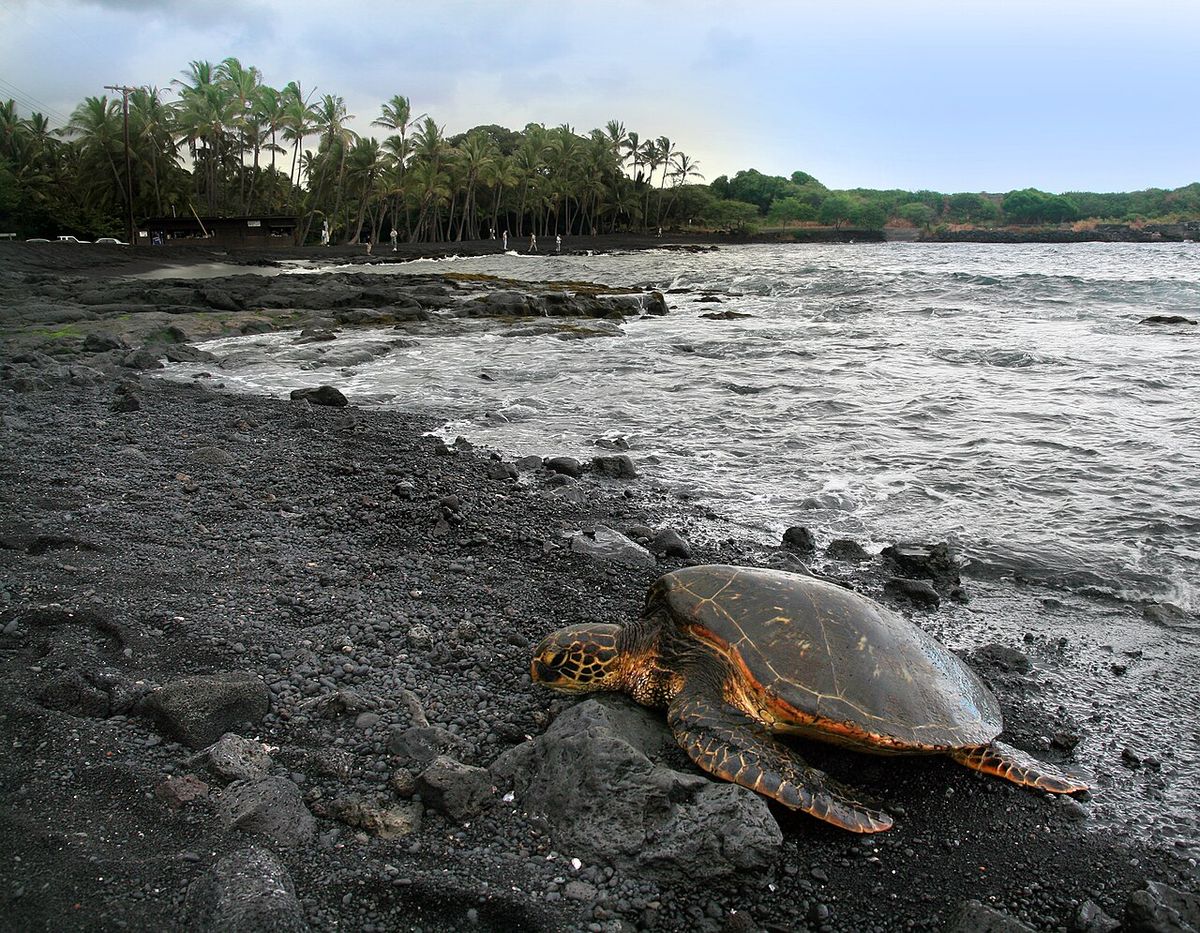
In Hawaiian tradition, a Moʻo is a freshwater reptilian spirit, sometimes as small as a gecko and sometimes described as fifteen to thirty feet long, with iridescent black or green scales and the ability to assume human form to deceive prey. The Moʻo of Punaluʻu Black Sand Beach on Hawai'i Island's southern Ka'ū coast is one of the most continuously-reported of these creatures. Oral tradition places her in the Kauila fishpond immediately behind the beach, where her presence was first recorded in a 1823 London Missionary Society journal by William Ellis. She is said to lie coiled on the black sand by day, indistinguishable from the driftwood, and to enter the pond at dusk.
Multiple modern sightings have been reported, most recently a 1993 encounter in which two University of Hawai'i marine biology students observed what they described as an 'enormous, glossy black reptile' perhaps twelve feet long moving across the beach and sliding into the pond at sunset. They reported it to NPS staff who in turn referred it to the county, where Ka'ū elders identified the creature immediately as the Punaluʻu Moʻo. In 2008, a ranger at Hawai'i Volcanoes National Park described the sound of 'very heavy dragging' across gravel at Punaluʻu on a moonless night, though he could see nothing.
Biologically, the southern Ka'ū coast is home to green sea turtles (Chelonia mydas), hawksbills (Eretmochelys imbricata), and monitor-sized feral reptiles whose origin is uncertain — including possible offspring of the common tegu introduced to Hawai'i in the 1980s. Whether the Moʻo represents an invasive-species misidentification, a folkloric archetype, or a genuine as-yet-uncatalogued creature, the cultural tradition remains strong. Kahuna practitioners continue to leave offerings at the brackish edge of Kauila Pond, and visitors are asked not to sit on the black sand after sunset.