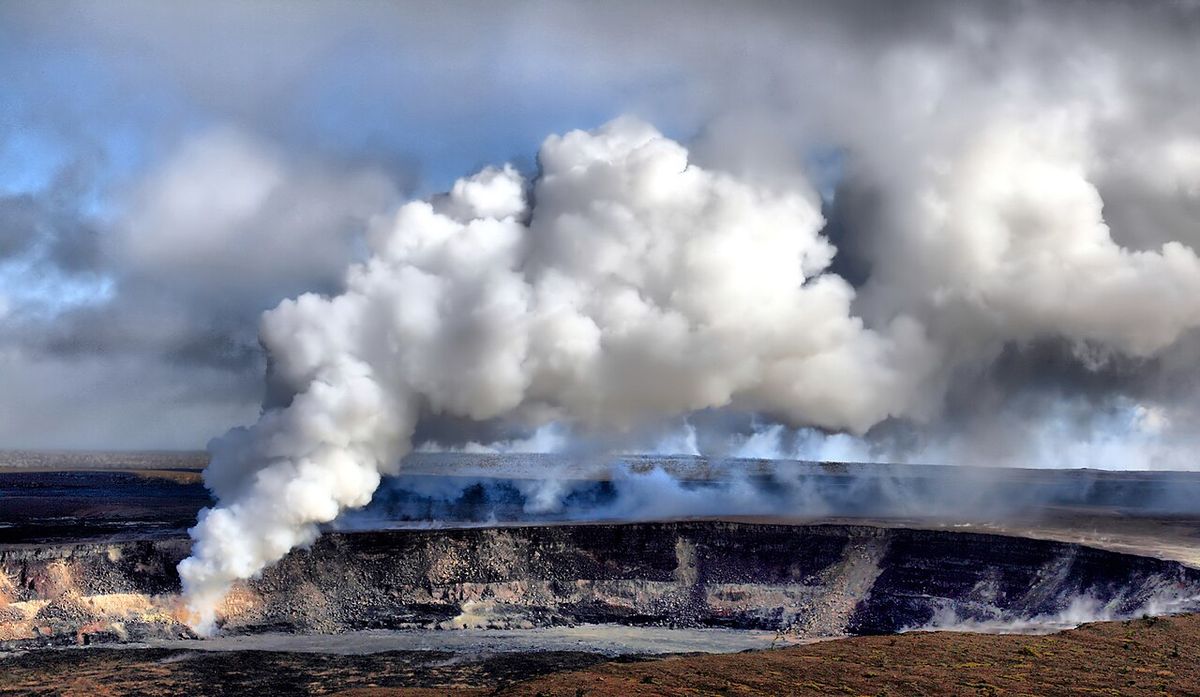
Pele, Hawaiian deity of volcanoes, fire, lightning, wind, and the creation of new land, is arguably the most continuously-observed supernatural figure in the United States. Her home is the Halema'uma'u crater within the summit caldera of Kīlauea on Hawai'i Island, though she is said to travel the length of the chain. Traditional chants describe her appearing as either an elderly woman in white accompanied by a small white dog, or a strikingly beautiful young woman in a red gown — in both cases seeking a ride or a cigarette from passing travelers along Hawaii Belt Road. Motorists who refuse her are said to meet misfortune; those who offer her aid return to find she has vanished from the empty back seat.
The Pele-apparition tradition is not a minor element of modern Hawaiian folklore. Hawaii County Civil Defense and the USGS Hawaiian Volcano Observatory both received dozens of reports during the 2018 Lower East Rift Zone eruption — including a Puna resident who claimed to have given Pele (as an elderly woman in white) a ride hours before lava destroyed the community of Leilani Estates. Similar reports preceded the 1955 and 1960 Kapoho eruptions, the 1983 onset of Pu'u Ō'ō, and the 1990 destruction of Kalapana village. Park rangers at Hawai'i Volcanoes National Park catalog such sightings as part of the cultural-resources record and refer to her as 'the Lady.'
Belief in Pele actively shapes Hawaiian land policy and emergency response. Native Hawaiian practitioners leave daily offerings of food, flowers, and gin at Halema'uma'u, and the long-standing kapu against removing lava rocks from the island — enforced by park rangers who routinely receive returned rocks by mail from guilty mainland tourists — is grounded in the belief that to take from Pele is to invite her anger. Multiple Hawaiian governors, mayors, and USGS scientists have in formal statements acknowledged the Pele tradition as a legitimate cultural framework for interpreting volcanic activity.