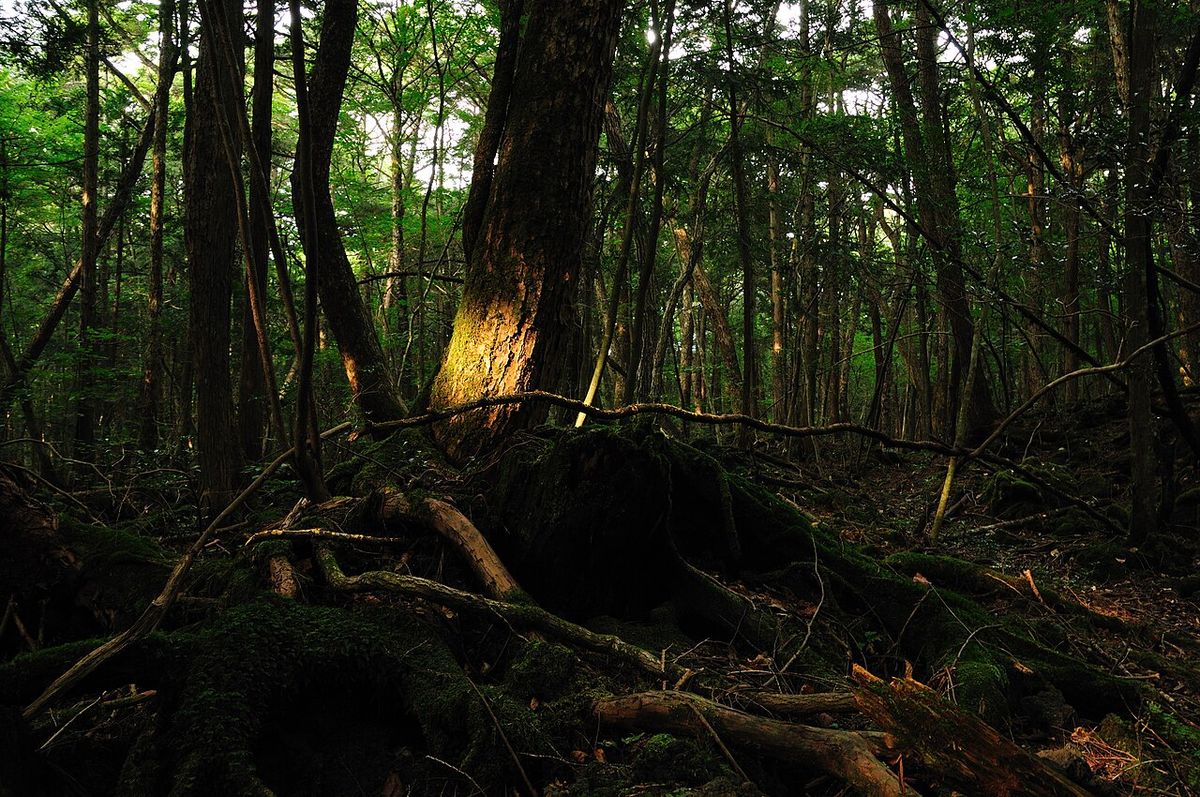
Aokigahara, the 30-square-kilometre forest on the northwestern flank of Mount Fuji, grew in the past 1,200 years over the lava field left by the 864 Jōgan eruption. The porous basalt absorbs sound and scrambles compasses; GPS often fails beneath the canopy, and the forest floor is honeycombed with ice caves and lava tubes. Aokigahara has become the world's second-most-frequent suicide site after the Golden Gate Bridge, with more than 100 bodies recovered annually at the peak, and has been part of Japanese folkloric tradition for at least a thousand years as a place where the spirits of the unhappy dead — yūrei — linger.
The forest's association with ubasute, the legendary practice of abandoning elderly relatives in wilderness, is partially fictional (derived from Seichō Matsumoto's 1960 novel 'Kuroi Jukai') but draws on genuinely ancient folk traditions surrounding Mount Fuji as a mountain of the dead. In pre-modern tradition, the hungry ghosts of those who died there — gaki — feed on the negative emotional charge of the living, and the forest is said to emit a low hum that some hikers describe as 'voices in the leaves' where no birds sing. Japanese Self-Defense Forces conduct annual sweeps of the forest in partnership with local volunteers to recover remains; participants routinely refuse to describe what they experienced on the sweeps and report needing Buddhist purification ceremonies afterward.
Yamanashi Prefecture signs installed along Aokigahara's few trails urge visitors in crisis to contact the mental-health hotline and remind them that 'your life is a precious gift from your parents.' Novelist Wataru Tsurumui's 1993 'Complete Manual of Suicide' cited Aokigahara as 'the perfect place to die,' driving years of international attention that the prefecture regards with deep concern. Shinto and Buddhist priests from the nearby Fuji-san Sengen Jinja and Narusawa Hyōketsu shrines perform regular pacifications. For the Japanese paranormal community, Aokigahara is less a tourist haunt than the most charged intersection of living tradition, modern suicide crisis, and a landscape capable of losing visitors within hundreds of metres of their cars.