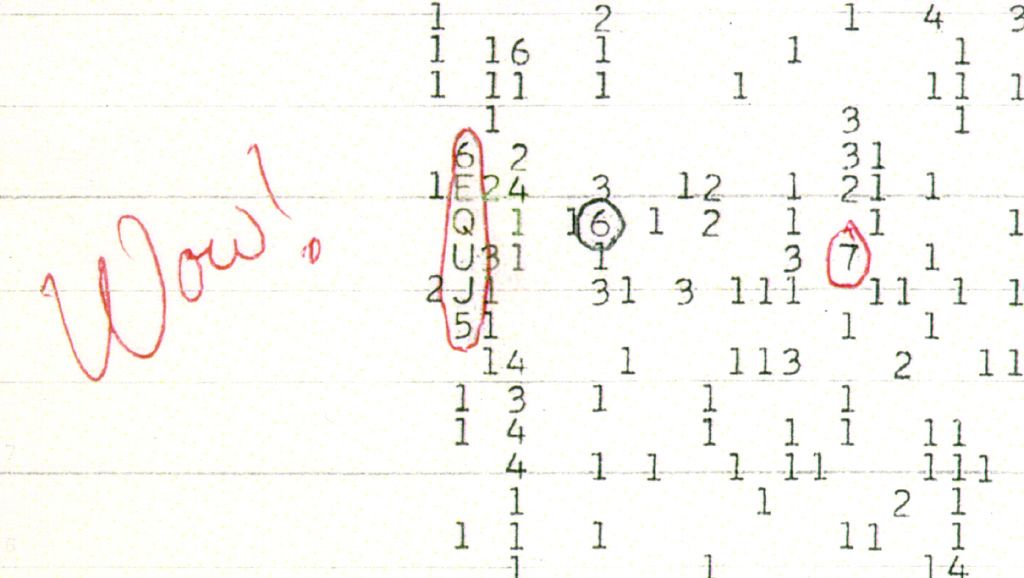
On the night of August 15, 1977, the Ohio State University radio observatory — nicknamed 'Big Ear' for its 360-foot-wide flat reflector and rotating tiltable antenna array outside the town of Delaware, Ohio — was conducting a survey of the sky as part of SETI (the Search for Extraterrestrial Intelligence) coordinator Dr. John Kraus's long-running project to catch a deliberately transmitted interstellar signal. Three days later, volunteer astronomer Dr. Jerry R. Ehman was reviewing computer printouts of the past weekend's data when one particular column of numbers stopped him cold. For roughly seventy-two seconds on August 15 at 22:16 EDT, Big Ear had recorded an intense, narrow-band radio signal at 1420.356 MHz — almost exactly the hydrogen-line frequency long hypothesized to be the preferred interstellar communication channel.
The signal's intensity followed the exact bell-curve shape expected of a point-source passing through Big Ear's fixed beam as the Earth rotated, ruling out terrestrial interference. Its strength rose to thirty times above background and then faded. The signal's sequence on the printout was '6EQUJ5' — coded representations of signal intensity — the highest 'U' representing a peak over thirty standard deviations. Ehman circled the sequence in red pen and wrote 'Wow!' in the margin, giving the signal its popular name.
Exhaustive follow-up observations with Big Ear, the Very Large Array, and other radio telescopes over the next thirty-five years failed to re-detect anything at the same coordinates in the constellation Sagittarius, near the globular cluster M55. No natural astrophysical source has ever matched the Wow! Signal's combination of frequency, narrowness, intensity, and absence of repetition. In 2017, researcher Antonio Paris proposed that the signal was caused by passing comets 266P/Christensen and P/2008 Y2 (Gibbs), but the hypothesis has been widely rejected on physical grounds.
The Wow! Signal remains the single most promising — and most frustrating — candidate radio signal in the history of SETI. It is the one undisputed anomaly the project has produced in sixty years of listening.