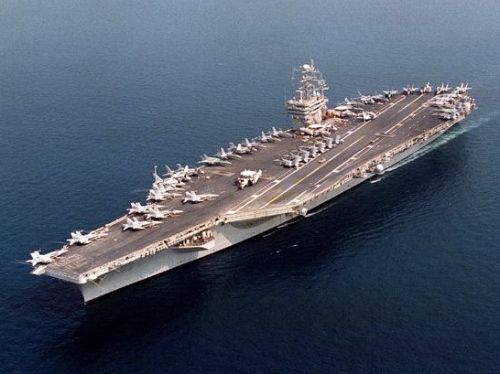
Over several days in November 2004, the USS Nimitz carrier strike group training off the coast of Baja California encountered unidentified aerial objects that became one of the most extensively documented military UFO events of the modern era. The Ticonderoga-class cruiser USS Princeton, equipped with the advanced AN/SPY-1 radar, had been tracking multiple slow-moving objects descending from altitudes above 80,000 feet to sea level in a matter of seconds — performance far beyond any known aircraft.
On November 14, two F/A-18F Super Hornets from Strike Fighter Squadron 41 ('Black Aces') were vectored to intercept a contact. The lead aircraft was piloted by Commander David Fravor with Lieutenant Commander Jim Slaight; their wingman was piloted by Lieutenant Commander Alex Dietrich. Approaching the coordinates, Fravor observed a white, smooth, oblong object roughly forty feet long — quickly nicknamed the 'Tic Tac' for its shape — hovering above a disturbance in the ocean. It had no wings, no exhaust, and no visible means of propulsion. When Fravor descended to investigate, the object rose to meet him, mirrored his movements, and then accelerated to disappear in under two seconds.
Seconds later, the Princeton reacquired the object at the Combat Air Patrol rendezvous point sixty miles away. A second flight led by Lieutenant Commander Chad Underwood captured forward-looking infrared video of a similar object; this thirty-four-second clip, later dubbed the FLIR1 video, was officially released by the Department of Defense in 2017.
The Nimitz encounter became publicly known in December 2017 when The New York Times published the FLIR footage together with details of the previously classified Advanced Aerospace Threat Identification Program. Testimony from Fravor, Dietrich, and Underwood before Congress in 2023 re-elevated the incident to national attention. It remains one of the most credible UFO events on record, involving multiple trained observers, two separate radar systems, and contemporaneous video evidence.