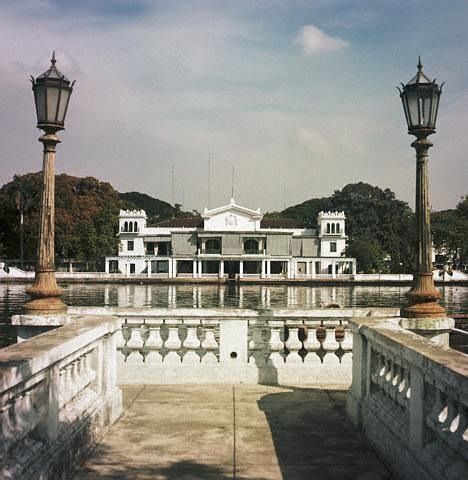
Malacañang Palace, the official residence and principal workplace of the President of the Philippines, is the most haunted government building in the country — a distinction earned through centuries of accumulated power, tragedy, and death within its walls. The palace's supernatural residents include former presidents, pre-Hispanic spirits, wartime dead, and a kapre who inhabits the heritage balete tree at the main entrance.
Three Philippine presidents who died in office are said to haunt the palace: Manuel L. Quezon (died of tuberculosis in exile in 1944), Manuel Roxas (died of a heart attack in 1948), and Ramon Magsaysay (died in a plane crash in 1957). Their ghosts are reported in the areas of the palace where they worked and lived, appearing in the corridors, offices, and residential quarters that they occupied during their terms. The presidential ghosts are described as purposeful rather than distressed — walking their old routes, sitting at their old desks, continuing the work of governance that defined their lives.
The palace's most consistently reported apparition is a black lady — not the more common white lady — who peers out toward the Pasig River from a window of Mabini Hall late at night. Her identity has never been established, but her persistent vigil at the window, watching the river, suggests a connection to someone who arrived at or departed from the palace by water during an earlier era.
Former presidential aides, attendants, and household staff also contribute to the palace's spectral population. Guards report seeing figures in staff uniforms from various decades moving through the service areas of the palace after hours.
The heritage balete tree at Freedom Park, designated a National Heritage Tree in 2011, is claimed to be the home of a kapre. The tree, with its massive trunk and aerial roots, predates the modern palace complex, and the kapre who inhabits it represents the pre-colonial spiritual landscape over which the symbols of Philippine political power were constructed.
The areas of highest reported activity include Mabini Hall, Heroes Hall, the Correspondence Office, the New Executive Building, and the Music Room — each carrying the accumulated energy of decisions, ceremonies, crises, and celebrations that have shaped the nation's history.