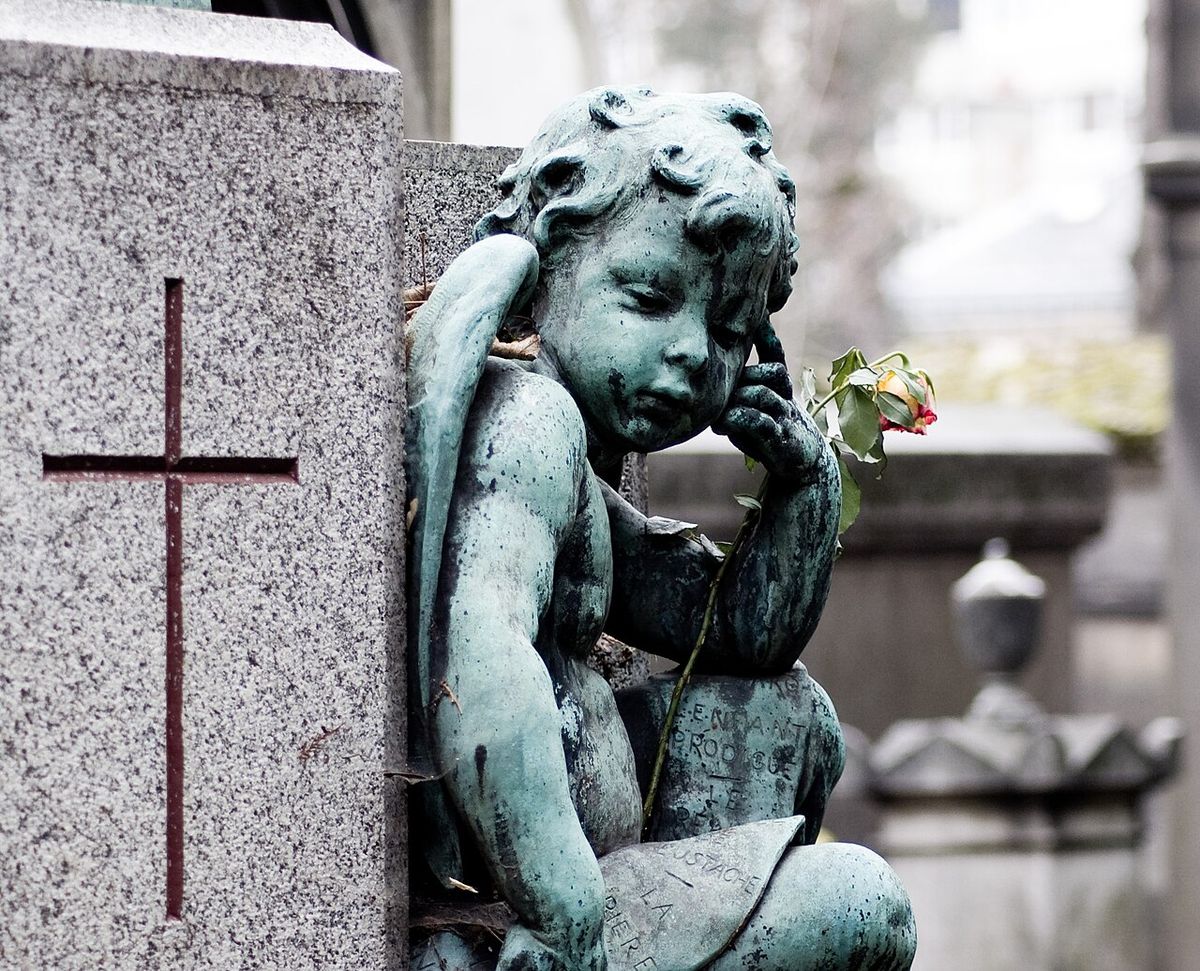
Père Lachaise Cemetery, consecrated in 1804 on the eastern hills of Paris, covers 44 hectares and contains more than one million interments — making it the largest cemetery in Paris proper and among the most famous in the world. Its permanent residents include Jim Morrison (d. 1971), Oscar Wilde (d. 1900), Frédéric Chopin (d. 1849), Édith Piaf (d. 1963), Marcel Proust (d. 1922), Honoré de Balzac (d. 1850), Colette (d. 1954), Sarah Bernhardt (d. 1923), Modigliani (d. 1920), and — symbolically — Héloïse and Abélard, whose twelfth-century lovers' tomb was transferred to Père Lachaise in 1817 to boost early burials at the then-unpopular location. The cemetery's supernatural reputation is as old as its grounds.
The most famous apparition is that of a young man in nineteenth-century evening clothes who approaches female visitors near the Allée des Acacias — reputed, in the cemetery's folklore, to be the ghost of a suicide whose burial was refused. Visitors to Jim Morrison's grave have reported the sound of his voice from the path and — on the anniversary of his July 1971 death — the smell of burning cannabis in sections where no visitor is present. The Communards' Wall, where 147 surviving Paris Commune fighters were summarily executed by the French army on May 28, 1871, produces the cemetery's most intense concentration of phenomena: voices crying in nineteenth-century French, sudden atmospheric pressure changes, and multiple reports of ragged figures in blue working-class clothes observed near the wall at dusk. A 2004 recording captured by the Société Paranormale de France registered what appears to be a chorus of men singing 'La Marseillaise' in the vicinity of the wall during an empty-cemetery overnight investigation.
Père Lachaise's combined literary fame, revolutionary trauma, and the unusual density of its interred population — including many whose deaths were violent or untimely — give it a concentrated paranormal character unique in Europe. Night tours are prohibited by Paris regulations, but daytime visits routinely produce firsthand reports from casual visitors. The cemetery's chief archivist has in multiple interviews acknowledged that staff encounters with unexplained phenomena are sufficiently common that new employees are briefed about them as a matter of routine.