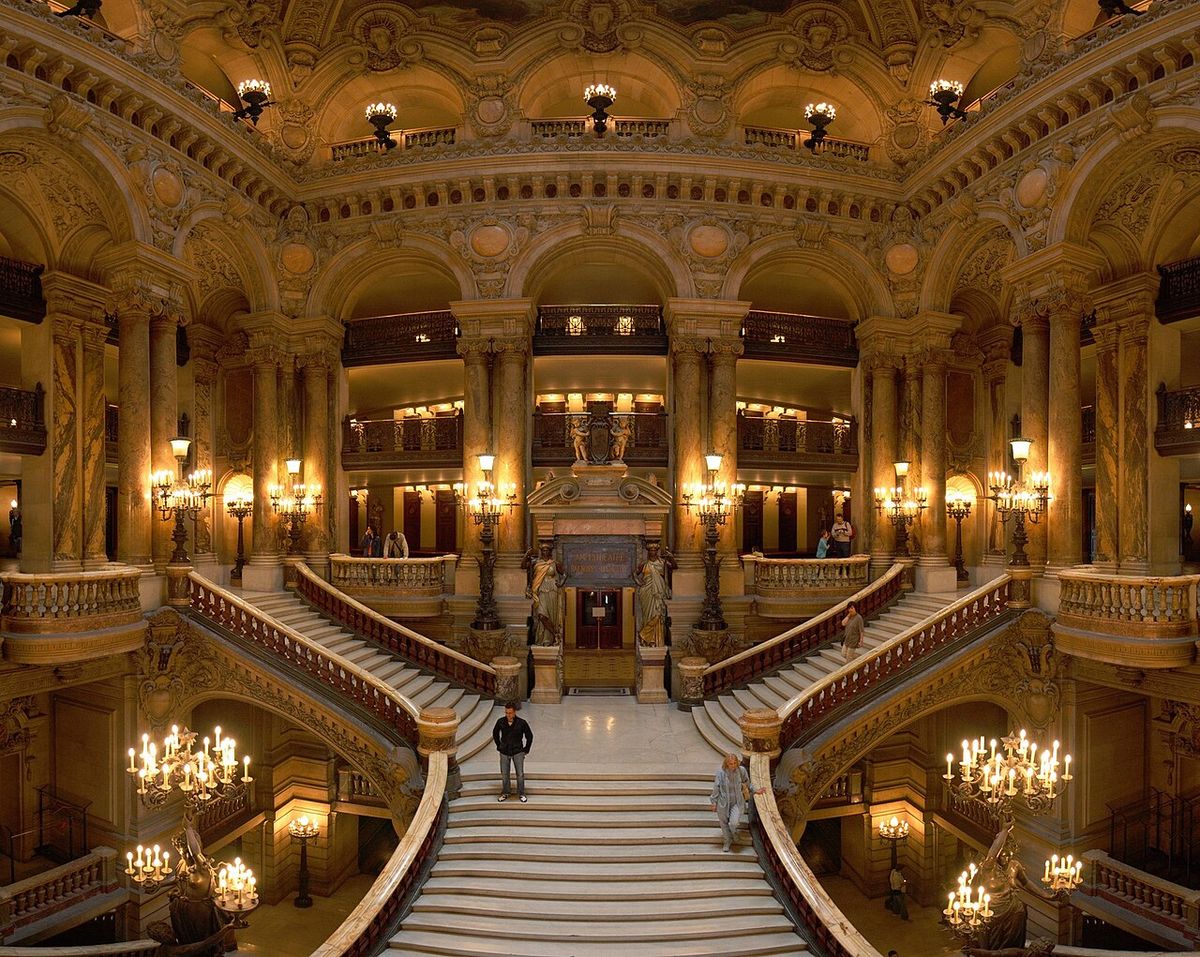
The Palais Garnier, the ornate opera house designed by Charles Garnier and opened in 1875 on the Place de l'Opéra in Paris, is the factual source of Gaston Leroux's 1910 novel 'Le Fantôme de l'Opéra' ('The Phantom of the Opera'). Leroux himself, in the preface to his novel, insisted that the opera ghost was 'not a figment of the imagination' but an actual figure known to opera personnel at the time of his writing. The underground lake which features prominently in the novel is a real subterranean cistern, constructed during the building's foundation work between 1861 and 1875 to manage the unexpectedly high water table of the Place de l'Opéra. The cistern remains in place and is still used by Parisian firefighters for training exercises.
Opera ghost reports predate Leroux. From the Palais Garnier's opening in January 1875 onward, house staff reported a recurring figure in a dress coat in specific private boxes — particularly Box 5, which was reserved on occasion for no patron. A genuine 1896 incident during a performance of 'Hellé' saw the grand chandelier — weighing 8 tonnes — partially fall from the ceiling, killing one concierge; Leroux incorporated this real event into his novel's climax. Reports of a disfigured man observed in the ballet dancers' dressing rooms and in the lower foyers appeared in Le Figaro as early as 1887, framed as a curiosity of backstage opera life.
Modern reports from the Palais Garnier staff, including documentation by the Paris Opera Ballet's own administrative office, continue to include: the figure of a man in evening clothes observed seated in Box 5 during empty rehearsals; the sound of a distant male voice singing in the sous-sol corridors; unaccountable temperature drops in the Grand Foyer; and recurring mechanical anomalies in the chandelier-hoisting system. The Palais Garnier's archivist maintains a discreet internal log of incidents. Whether the opera ghost of the Palais Garnier was originally a real individual — the most common hypothesis is an eccentric resident of the building's period, possibly an engineer or workman disfigured during construction — or a purely paranormal manifestation, the tradition is one of the few in the world where the fictional and the factual version of a ghost have equal standing in popular culture.