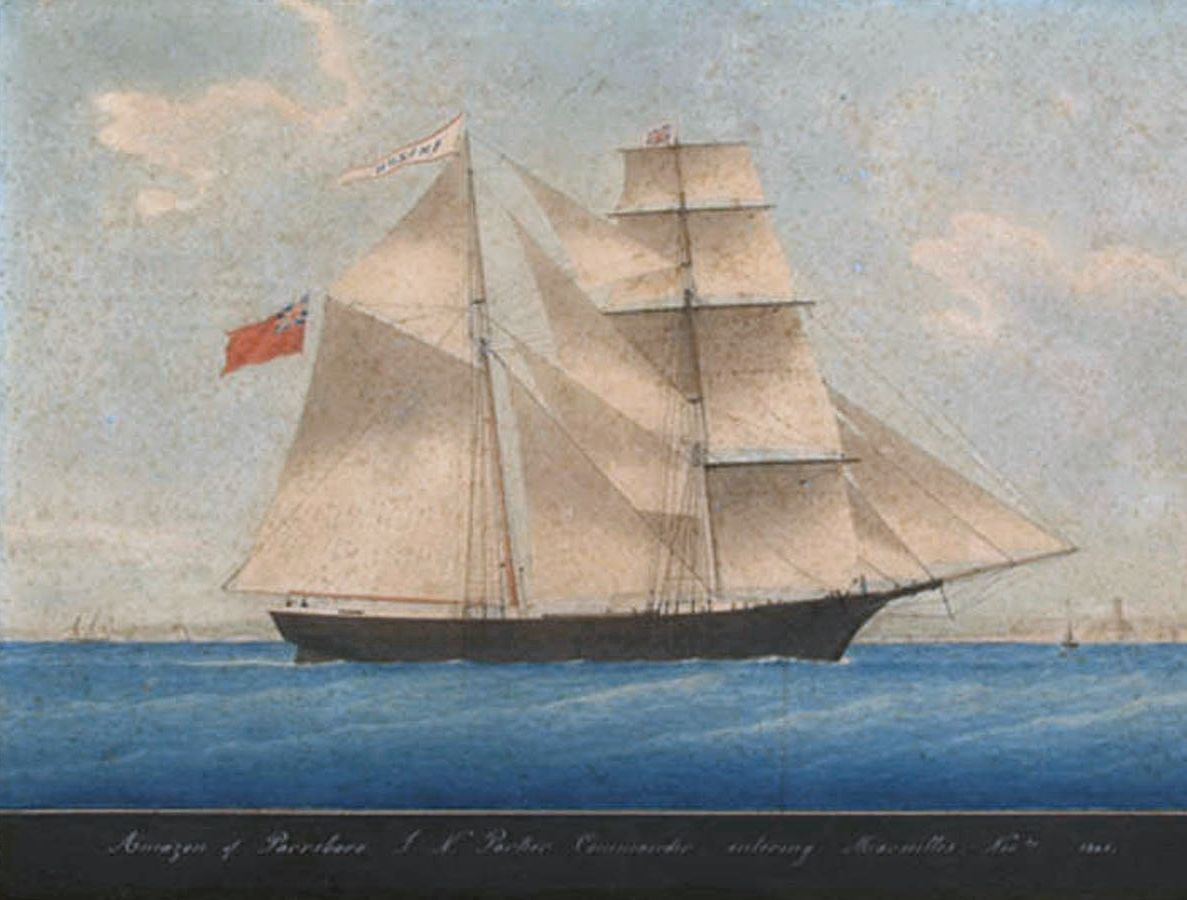
On December 5, 1872, the British-Canadian brigantine Dei Gratia, sailing from New York to Gibraltar, sighted a ship drifting erratically about six hundred miles west of Portugal. The vessel was the American merchant brigantine Mary Celeste, which had sailed from New York eight days before the Dei Gratia carrying a cargo of 1,701 barrels of denatured alcohol bound for Genoa. Under Captain Benjamin Spooner Briggs, she had carried a crew of seven, his wife Sarah, and their two-year-old daughter Sophia.
Dei Gratia's chief mate Oliver Deveau boarded the Mary Celeste and found her completely deserted. The lifeboat was missing. The cargo of 1,701 barrels was intact, though nine barrels had leaked. Six months of food and water were in the hold. The captain's cabin was in order; personal possessions, including Mrs. Briggs's sewing kit and valuable jewelry, were untouched. The ship's papers were missing, but the captain's log was present; its last entry was dated November 25, ten days before the discovery, recording a position about four hundred miles from where the ship was found. No distress signals had been sent. There was no sign of struggle, no blood, and no indication of foul play. The ship's only oddities were a few feet of water in the hold, two opened hatches, and a severed halyard.
The Dei Gratia sailed the Mary Celeste to Gibraltar, where a British Admiralty court investigated over three months. Suspicions of mutiny, piracy, and insurance fraud were all considered and rejected. The court reluctantly awarded a salvage fee of just £1,700 — about one-fifth the vessel's value — reflecting the judge's unresolved suspicions. The most widely accepted modern theories involve a partial explosion of alcohol vapor from the leaking barrels, or the captain's belief that the ship was sinking, leading the entire party into the lifeboat, which was then lost.
The Mary Celeste remains the archetypal 'ghost ship' of Western maritime tradition and is the most famous abandonment mystery in the history of seafaring.