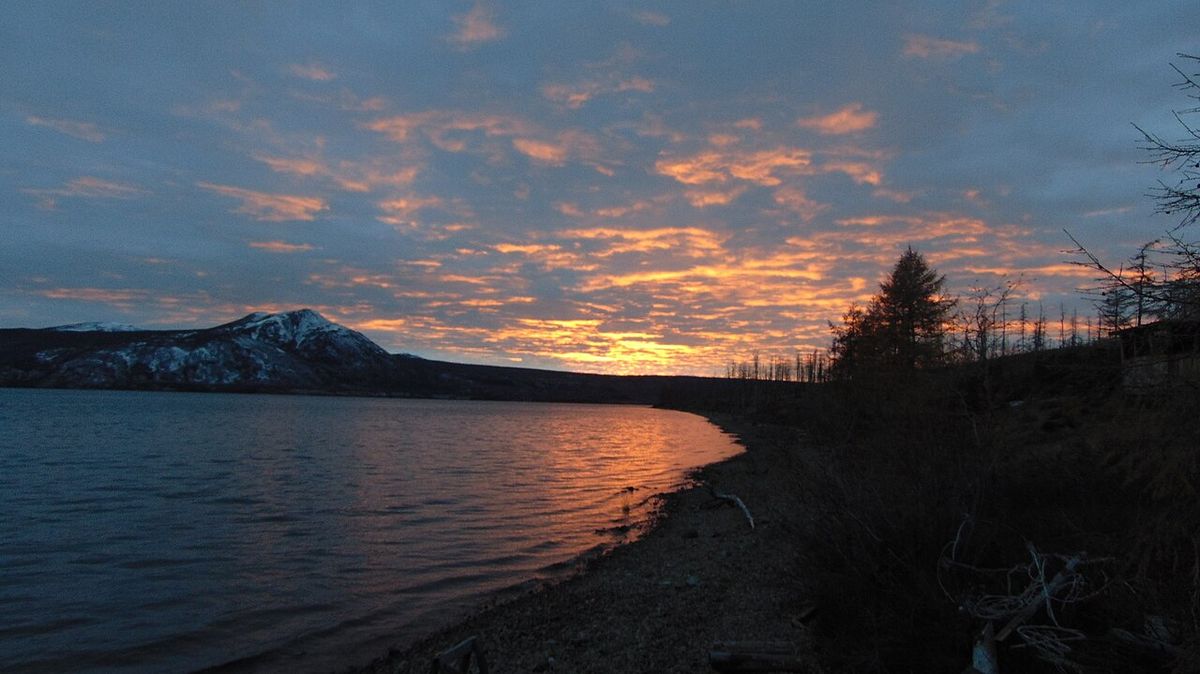
Lake Labynkyr (Лабынкыр), a 14-square-kilometre lake at 1,020 metres elevation in the Oymyakon District of the Sakha Republic (Yakutia) of eastern Siberia, is one of the coldest inhabited places on Earth — with recorded winter temperatures as low as –65°C — and reputedly home to one of the world's most remote cryptids. Sakha (Yakut) oral tradition extending back at least 500 years describes a creature called the Labynkyr Devil (Лабынкырский чёрт): a dark grey, snake-like animal approximately 10 metres long with a massive jaw that has been credited with attacks on reindeer, dogs, and occasional human swimmers in the short summer open-water season.
The first formal Russian scientific expedition to Labynkyr was led by geologist Viktor Tverdokhlebov in 1953, who published a widely-cited account of observing with his assistant a dark mass 'with markings on the neck' moving across the lake surface. In 1962, Soviet geologist A. Panteleev reported observing from a high ridge above the lake a 'jaw-like animal' approximately 10 metres long at a distance of roughly 300 metres. In 2013, the Russian Geographical Society sponsored an expedition led by Dmitry Shiller that used sonar and underwater cameras; the team reported multiple sonar contacts at 54 metres depth consistent with a large organic mass. The expedition's findings were published in the Russian Geographical Society's annual report.
Proposed identifications include a northern pike (Esox lucius) of exceptional size — specimens up to 1.5 metres are known from Labynkyr — an escaped Siberian sturgeon (Acipenser baerii), or a surviving ice-age relic fish species. The lake's unusual characteristics — it does not freeze completely even in January despite ambient temperatures of –60°C, suggesting geothermal-vent activity at depth — provide a plausible refugium for an unusual species. Labynkyr's remoteness (the nearest settlement is Tomtor, 80 kilometres distant, and the lake is inaccessible for most of the year) has made definitive investigation difficult, and the Devil of Labynkyr remains perhaps the least-studied but most intriguing of the major Eurasian lake cryptids.