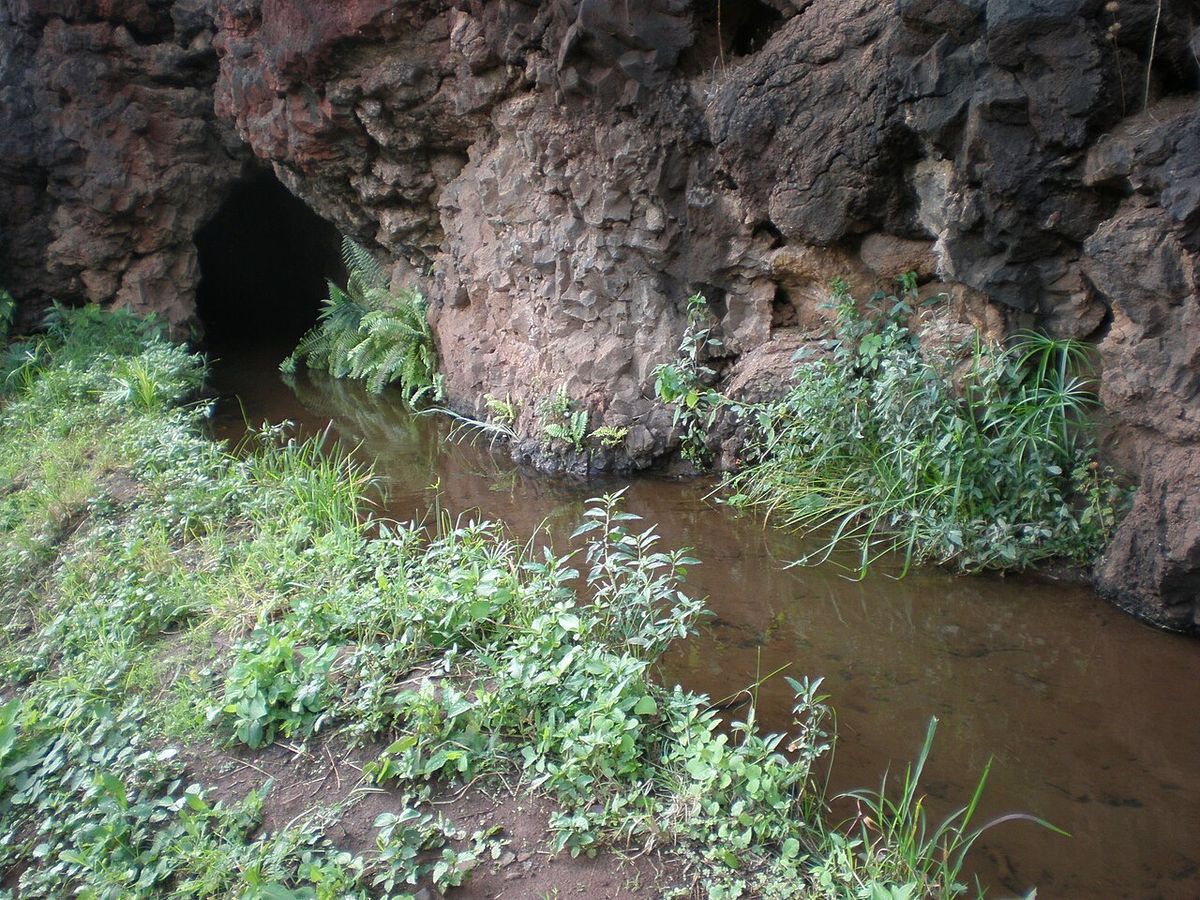
The Kīkīaola, commonly called the Menehune Ditch, is an aqueduct hewn from and fitted with cut stone that runs along the Waimea River on Kaua'i's west side. Unlike any other pre-contact Hawaiian construction, the ditch's walls use dressed, squared lava blocks fitted with precision comparable to Incan or Bronze Age Mediterranean masonry — a construction technique not otherwise attested anywhere in Polynesia. When Captain George Vancouver's 1793 expedition documented the structure, local Kaua'i Hawaiians told him unequivocally that they did not build it; it had been there before their ancestors, and had been constructed by 'the small people' working a single night.
The tradition holds that Chief 'Ola commissioned the work of the Menehune in exchange for a single shrimp-feast, and that the ditch was completed between sundown and the first cock-crow. A second oral tradition describes part of the wall collapsing and being rebuilt the following night when 'Ola offered a second feast. Radiocarbon dating of organic inclusions in the ditch's matrix has produced anomalous results ranging from 1,100 BCE to 900 CE — several centuries before the earliest generally-accepted Polynesian colonization of the Hawaiian Islands (c. 1000–1200 CE). This has led Alu Like cultural researchers and a minority of academic archaeologists to argue that the Kīkīaola may represent the work of an earlier, possibly Marquesan or Tahitian exploratory wave now entirely subsumed or replaced.
Modern Native Hawaiian practitioners continue to leave offerings at the visible portion of the ditch along Menehune Road near Waimea town. Hikers in the upper Waimea Canyon have reported, on rare occasions, small figures observed at the treeline and the sound of chanting and small percussion rising from dry streambeds at night. The Kīkīaola remains the single most concrete, archaeologically-attested basis for the Menehune tradition: a visible piece of stonework that the people who lived alongside it for a millennium explicitly denied having built.