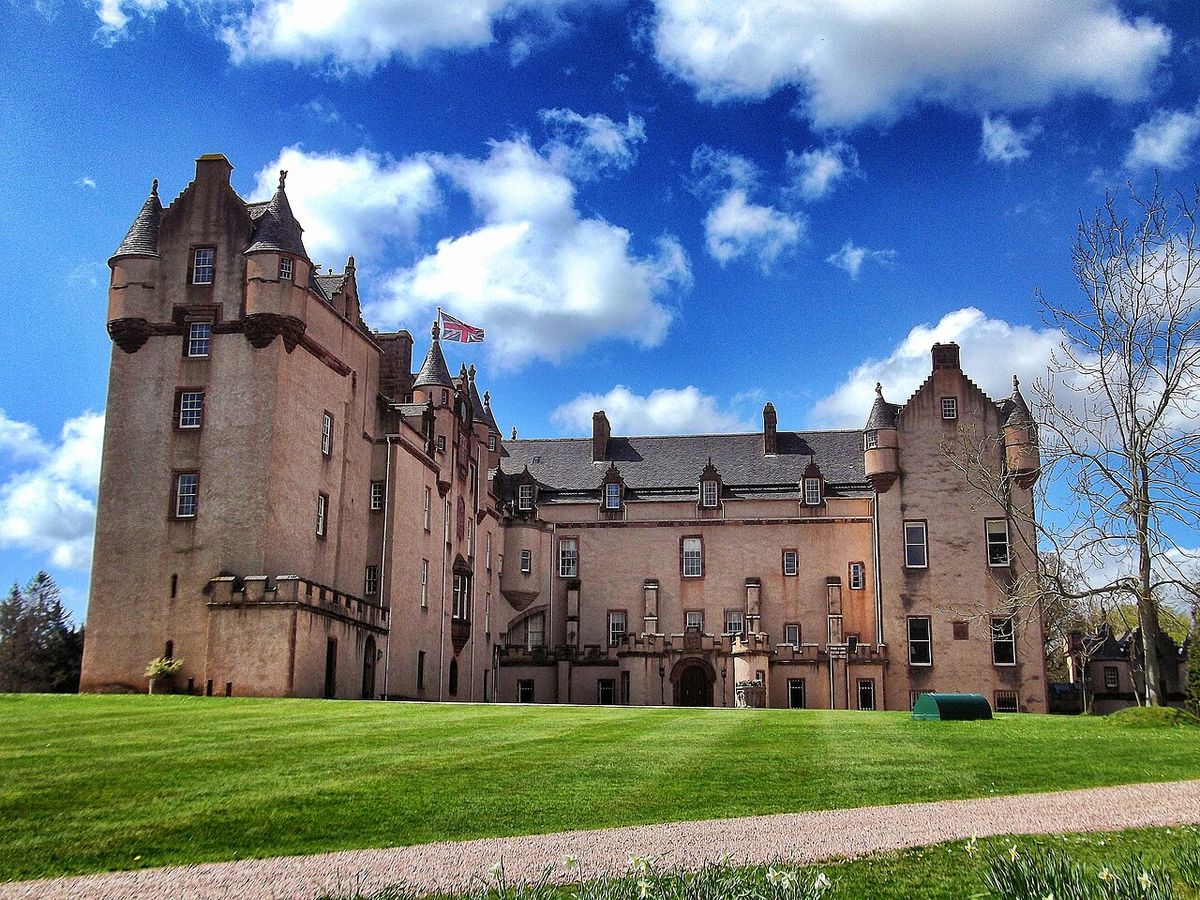
Fyvie Castle in Aberdeenshire, Scotland, is a magnificent fortress with roots stretching back to the 13th century. Passed through the hands of five powerful Scottish families — the Prestons, Meldrums, Setons, Gordons, and Leiths — each left their mark on its towering walls. They also, according to centuries of testimony, left their dead behind.
The castle's most famous ghost is the Green Lady, also known as Dame Lilias Drummond. Lilias was the wife of Alexander Seton, first baronet of Fyvie, and died in 1601 under circumstances that invited suspicion. Her husband remarried with conspicuous haste, and on his wedding night, the name "D. LILIAS DRUMMOND" was found scratched into the stone window ledge of the bridal chamber — a ledge accessible only from outside, fifty feet above the ground. The inscription remains visible to this day. Staff and visitors have reported her spectral green-clad figure drifting through the Drummond Room and adjacent corridors, accompanied by a heavy floral scent.
Fyvie is also haunted by the ghost of a woman whose skeleton was discovered behind a bedroom wall during 19th-century renovations. When the bones were removed, violent poltergeist activity erupted throughout the castle. The disturbances ceased only when the remains were returned to their resting place within the walls. A prophecy attributed to Thomas the Rhymer curses anyone who possesses all three of Fyvie's ancient "weeping stones," and the castle's owners have long avoided collecting the trio. The castle remains one of Scotland's most extensively documented haunted houses.