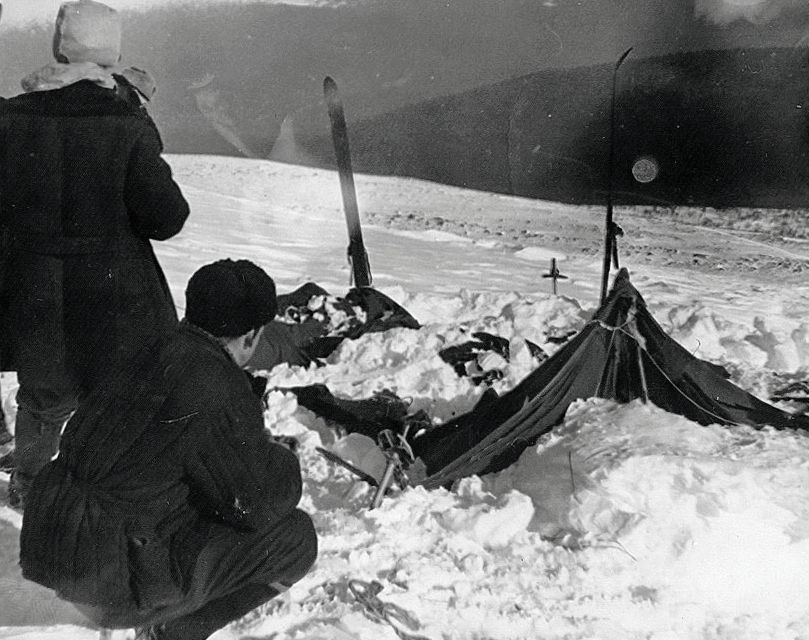
In late January 1959, a group of ten experienced ski-trekkers from the Ural Polytechnic Institute in Sverdlovsk (modern Yekaterinburg) set out for a sixteen-day expedition through the northern Ural Mountains, a Category III winter route of the highest difficulty. Their leader was twenty-three-year-old engineering student Igor Dyatlov. One member, Yuri Yudin, turned back on January 28 due to joint pain. The remaining nine — seven men and two women — continued toward the summit of Otorten. None returned.
When the group failed to send the expected telegram by February 20, a search was launched. On February 26, searchers found the expedition's tent on the eastern slope of Kholat Syakhl — a mountain whose Mansi name translates as 'Dead Mountain.' The tent had been cut open from the inside, and its occupants had fled down the slope in nothing but socks, underwear, and pajamas in −30 °C temperatures. The bodies were found over the following weeks across a half-mile stretch of forest. Six had died of hypothermia. The other three — Rustem Slobodin, Lyudmila Dubinina, Semyon Zolotaryov, and Nikolai Thibeaux-Brignolle — had suffered massive chest and skull fractures that a forensic pathologist compared to the impact of a vehicle collision. Dubinina's body was missing its tongue, eyes, and parts of its lips.
The original Soviet investigation concluded that the hikers had died from a 'compelling natural force,' without specifying what, and sealed the case for three decades. Later hypotheses have included a Mansi tribal attack (later ruled out), a military weapons test, an avalanche, infrasound-induced panic from the shape of the mountain, and paradoxical undressing during terminal hypothermia. In 2020, Russian prosecutors issued a final report attributing the deaths to a slab avalanche combined with katabatic wind, while a 2021 study using snow-avalanche simulation software supported that hypothesis.
Many researchers remain unsatisfied. The Dyatlov Pass incident is one of the most enduring mysteries of the twentieth century, the subject of hundreds of books, films, and scientific papers, and a permanent emblem of the Soviet Union's most inexplicable death.