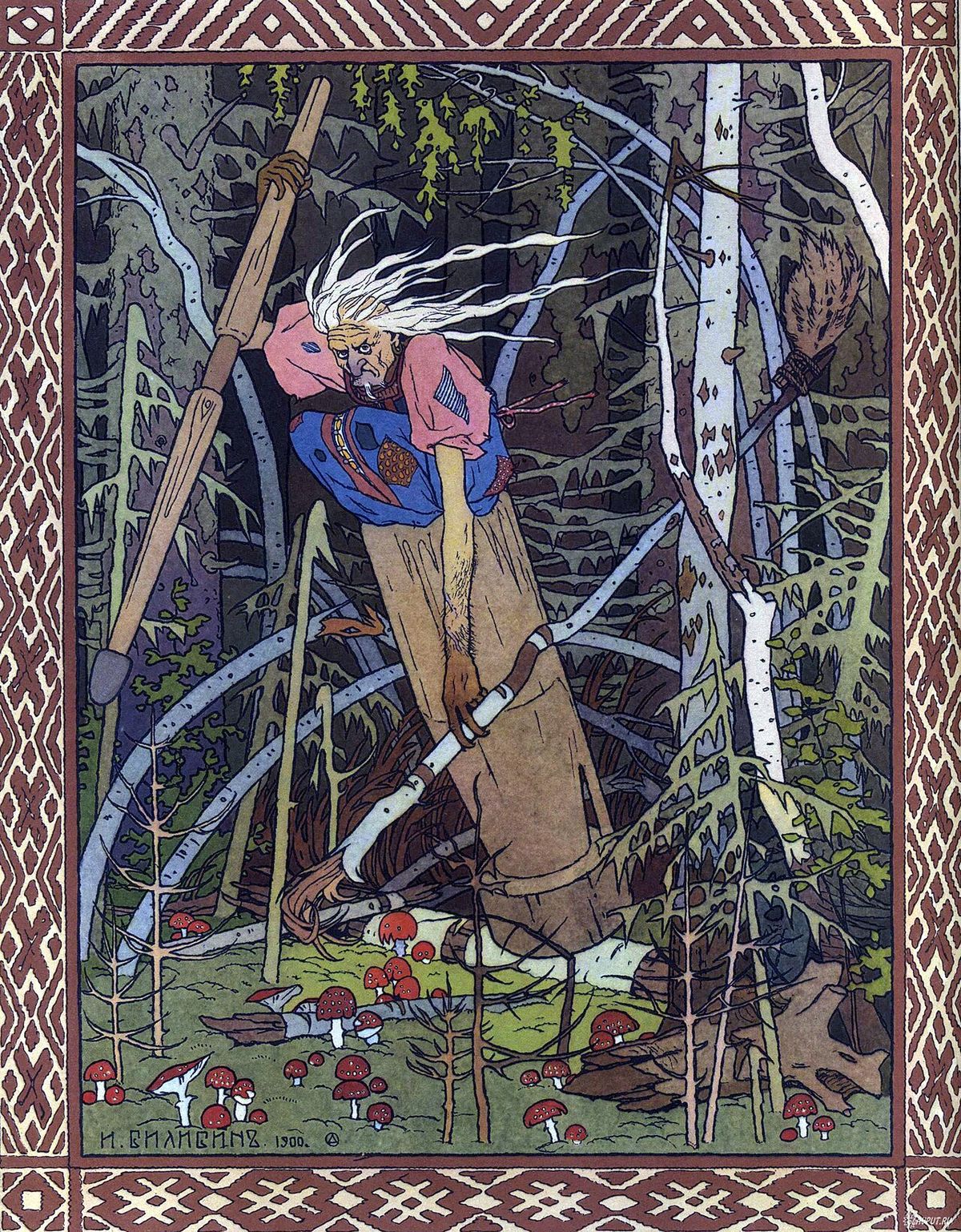
Baba Yaga is the most recognisable supernatural figure in Slavic folklore — a fearsome old woman who lives in a wooden hut that stands on a single giant chicken leg, surrounded by a fence topped with the glowing skulls of her victims. The figure is attested across a vast cultural zone encompassing Russia, Ukraine, Belarus, Poland, the Czech lands, Slovakia, and the Baltic, with regional variants such as Jędza in Polish tradition and Ježibaba in Slovak and Czech tales. Her name means, roughly, 'grandmother witch,' and she has appeared in folktales continuously since at least the earliest recorded Russian manuscripts.
Baba Yaga is traditionally depicted as tall and thin with a long, hooked iron nose, wiry hair, and bony legs. She rides through the forests of Eastern Europe seated in a giant wooden mortar, propelling herself with a pestle and sweeping away her tracks with a silver birch broom. Her domain is the deep ancient forest, particularly the region where the three kingdoms of the living world, the underworld, and the upper world meet. In many tales she appears not as a single figure but as three sisters, all named Baba Yaga, each guarding a further and deeper threshold in the protagonist's journey.
In the great story cycles collected by Alexander Afanasyev in the nineteenth century, Baba Yaga is both tormentor and helper. In tales such as 'Vasilisa the Beautiful,' she tests young heroines by setting impossible household tasks — sorting poppy seeds from ashes, cleaning her entire hut before sunrise — but rewards those who show courtesy or courage. In other tales, such as those of Ivan Tsarevich, she provides the hero with magical horses, enchanted objects, or the knowledge he needs to find the antagonist. Her hut turns only when she is addressed by the traditional rhyme: 'Little hut, little hut, turn your back to the forest and your front to me.'
Baba Yaga endures as the quintessential symbol of the ancient Slavic forest — a liminal, morally ambiguous figure whose hut's chicken-legged silhouette and whose bone-paled domain continue to influence literature, opera, ballet, folklore, film, and folk art far beyond the Slavic world.