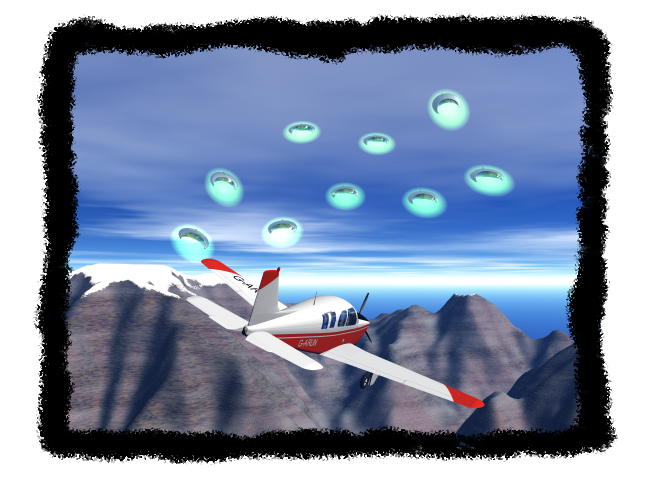
On the afternoon of June 24, 1947, private pilot Kenneth Arnold was flying his CallAir A-2 over the Cascade Range of Washington State, scanning for the wreckage of a missing Marine C-46 transport that carried a $5,000 reward. Near Mount Rainier at roughly 9,500 feet, a brilliant flash of light caught his eye. Arnold banked and saw nine bright, crescent-shaped objects flying in a diagonal chain between Rainier and Mount Adams, weaving through the peaks at what he calculated to be at least 1,700 miles per hour — far faster than any known aircraft of the day.
Arnold watched the formation for roughly two and a half minutes before the objects disappeared south toward Mount Adams. When he landed in Yakima and later Pendleton, he described their motion to reporters as 'like a saucer if you skip it across the water.' An East Oregonian reporter compressed the phrase into 'flying saucers,' and within days the term had entered the English language and spread across the world.
Arnold was an experienced mountain pilot, a deputy federal marshal, and a respected businessman, and his account was taken seriously by the Army Air Forces, which launched a formal investigation. Project Sign, Project Grudge, and ultimately Project Blue Book all grew out of the Air Force's scramble to understand what Arnold and hundreds of subsequent witnesses had reported during the summer of 1947. Within two weeks of his sighting, similar reports poured in from across the United States, including the Roswell crash of early July.
The Arnold sighting is universally regarded as the founding event of the modern UFO era. It occurred in daylight, was observed by an experienced aviator, involved multiple objects moving in coordinated formation, and produced a consistent description that shaped the public imagination for decades. The actual shapes Arnold drew were crescents — not classic saucers — but his offhand analogy fixed the image that has defined the phenomenon ever since.