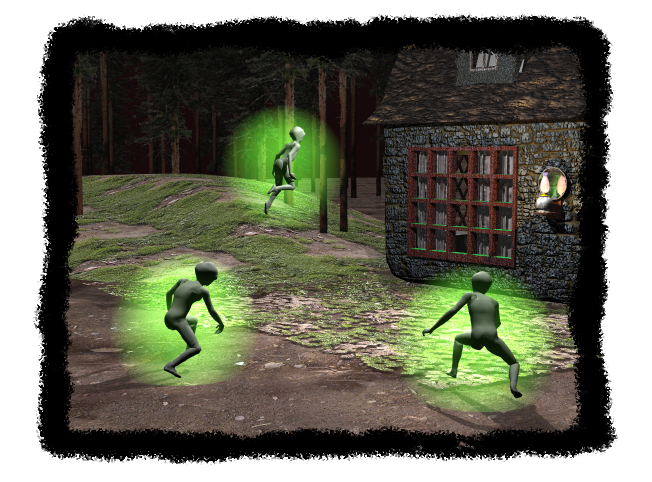
On the evening of August 21, 1955, eight adults and three children in the Sutton family farmhouse, located between the rural communities of Kelly and Hopkinsville in Christian County, Kentucky, endured what would become one of the most famous close-encounter-of-the-third-kind cases in American history. Billy Ray Taylor, a visiting friend, had gone out to the well around 7:00 PM to draw water when he reported seeing a bright object with an exhaust trail descend into a nearby gully.
About an hour later, the family's dogs began barking furiously in the farmyard. Taylor and Elmer 'Lucky' Sutton grabbed a shotgun and a .22 rifle and stepped outside, where they saw a small figure approach the house from the woods. The being was described as roughly three feet tall, with an oversized head, large pointed ears, glowing yellow eyes, long spindly arms ending in talons, and a silver-metallic appearance. The men opened fire. Their shots struck the figure, which flipped backward and scurried into the darkness, apparently unhurt. For the next three to four hours, multiple similar creatures approached the farmhouse, peeking through windows, perching on the roof, and reaching down from trees. The occupants fired round after round without visibly harming them.
At around 11:00 PM, the family broke for their cars, drove to the Hopkinsville police station, and reported being 'under siege by little men.' Police Chief Russell Greenwell, members of the Kentucky State Police, and military police from Fort Campbell all responded. They found the Sutton home in disarray, shotgun shells everywhere, holes in window screens, and the family genuinely frightened. No creatures were seen by the officers, but within hours of their departure the family reported that the beings had returned.
The Kelly-Hopkinsville encounter is widely credited as the origin of the modern 'little green men' trope and is frequently cited in abduction and close-encounter literature as one of the most witness-dense cases on record.