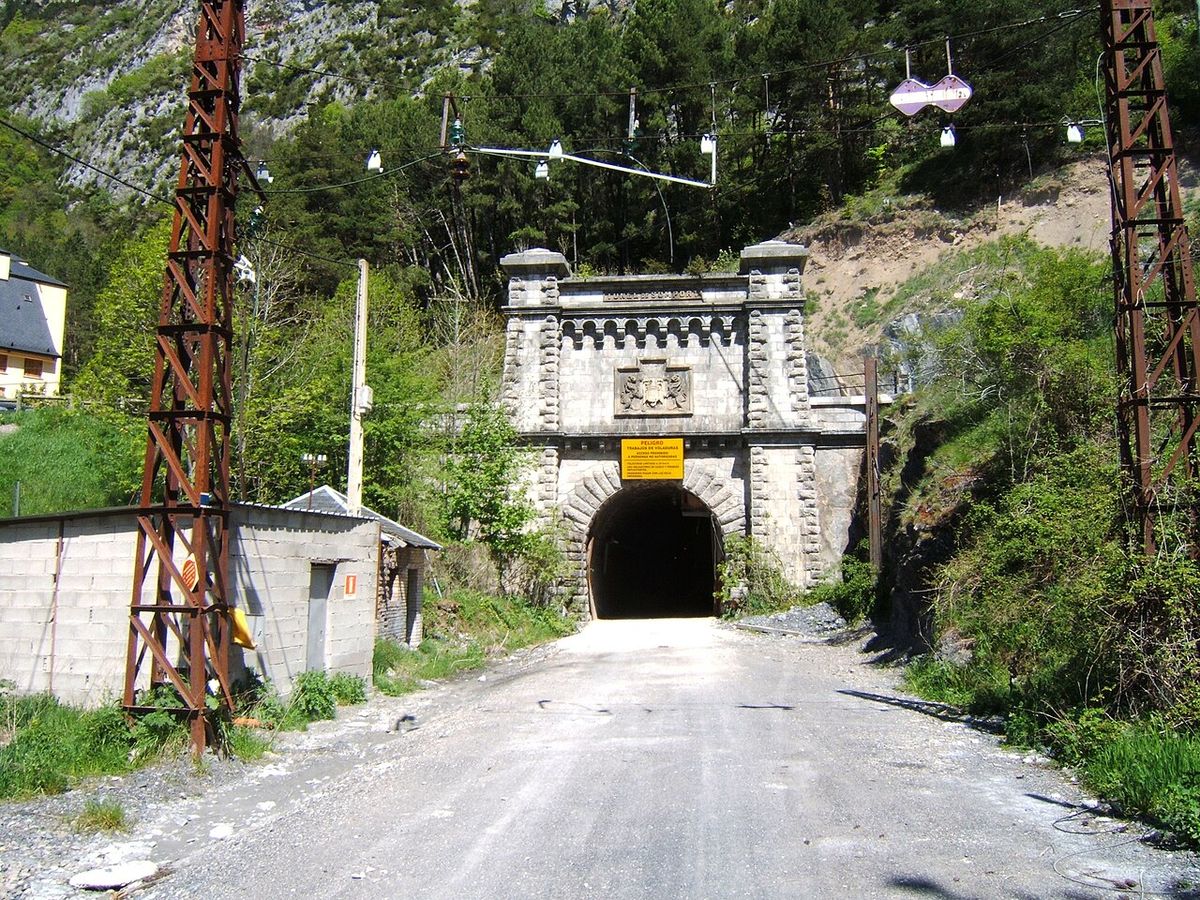
Canfranc International Railway Station, an enormous Art Nouveau structure in the Spanish Pyrenees near the French border, was completed in 1928 as the second-largest railway station in Europe (after Leipzig Hauptbahnhof). The station's 240-metre long double-façade was designed to accommodate trains on both the Spanish broad gauge and the French standard gauge, with a complex transshipment system for customs handling. Canfranc's brief period of full operation — from 1928 until 1970, when a derailment on the French side led to permanent closure of the cross-border line — coincided with the Spanish Civil War, the Second World War, and the Francoist period. During World War II, the station served as a vital transfer point for Nazi gold shipments to Francisco Franco's government, for tungsten-ore exports to the Third Reich, and as a critical escape route for approximately 14,000 Jewish refugees smuggled into neutral Spain.
Since the 1970 closure, Canfranc has stood largely empty in a steep Pyrenean valley. Spanish paranormal researchers have conducted periodic investigations in the building, documenting a consistent pattern of phenomena: the sound of trains on the platforms when no trains are present, muffled voices in multiple languages (Spanish, French, German, Portuguese, Yiddish) in the customs hall, the figures of uniformed customs officials and railway staff reported walking the empty corridors, and — most distinctively — the apparition of Albert Le Lay, the French stationmaster who smuggled refugees through Canfranc during the Nazi period and who died under unclear circumstances in 1945. Le Lay's figure has been reported in the stationmaster's office and on the French-side platform.
Canfranc is currently undergoing a €30 million restoration project to convert portions of the building into a luxury hotel, which opened partially in 2023. Restoration workers have extensively documented paranormal phenomena during the construction period, including the 2018 incident in which a night-watch crew observed a uniformed figure in 1930s railway attire walking the length of the customs hall. Canfranc's intersection of Art Nouveau grandeur, wartime trauma, multinational tragedy, and decades of decay has produced one of the most atmospheric haunted sites in Iberia, and it is now one of Europe's most unusual heritage-preservation projects.