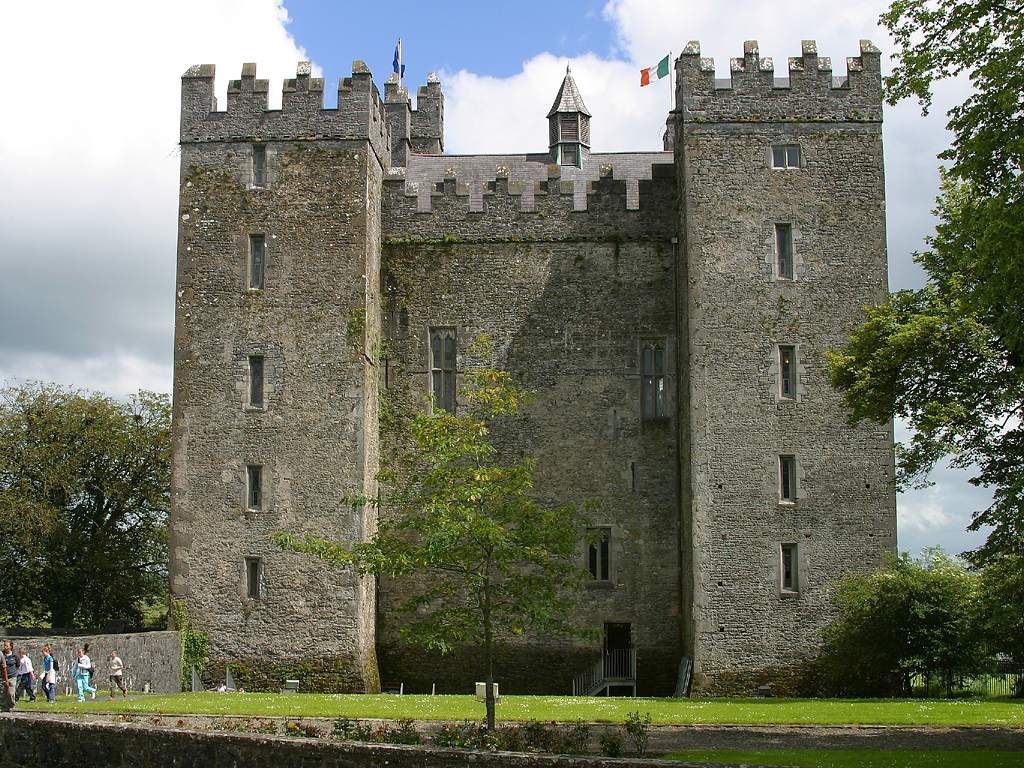
Bunratty Castle — a massive four-towered fifteenth-century tower house on the River Ratty in County Clare, western Ireland — has been associated with one of Ireland's most specific banshee traditions for more than five centuries. The castle was the principal stronghold of the Mac Conmara clan before passing to the O'Briens, Earls of Thomond, in the sixteenth century. According to Munster tradition, each of the great Gaelic families of Ireland was accompanied by a family banshee — a bean sídhe, or woman of the fairy mound — whose wailing could be heard on the nights before a death among the lineage. The banshee of the O'Brien family attached herself to Bunratty.
She was traditionally described as a slender woman in a long grey or white cloak, her face half-veiled by loose hair, seated on the wall or walking along the riverbank below the castle. Her cry was not a random howl but a distinct high, keening lament — the caoineadh, the formal Irish funerary wail — and she could be heard only by members of the O'Brien bloodline and their closest servants. In the most widely told version of the legend, her cry was heard on the nights before the deaths of Conor O'Brien, Third Earl of Thomond, in 1581 and of Donough O'Brien, First Earl of Thomond, in 1624. Later chronicles record the wail being heard on the nights preceding the deaths of O'Brien family members stationed abroad, including during the Irish Brigade's service in France in the eighteenth century.
The castle declined after the O'Briens abandoned it in the mid-seventeenth century, but the tradition survived. Twentieth-century restoration of Bunratty by Viscount Gort in the 1950s reopened the site as a museum, and the adjacent Bunratty Folk Park preserves many of the original Munster household narratives including those of the banshee.
The Bunratty banshee remains one of the most-localised and best-documented examples of the Irish banshee tradition — a survival of the ancient Gaelic belief that every great family walks alongside its own mourning spirit.