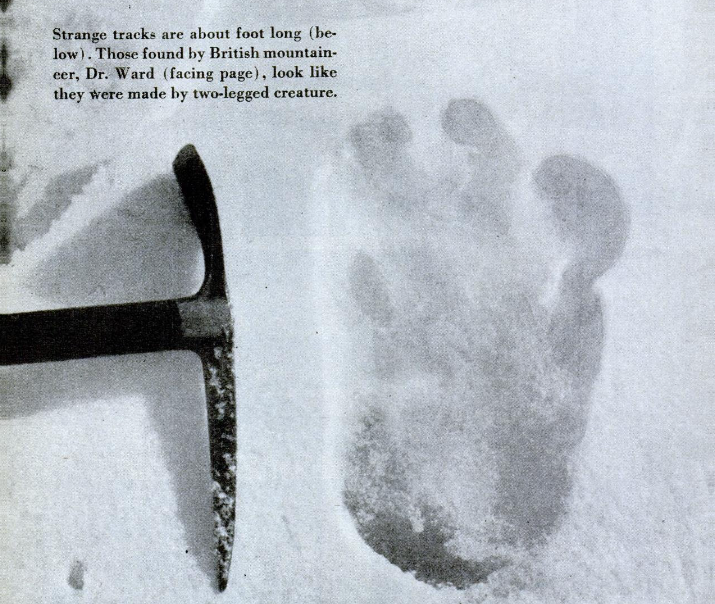
On November 8, 1951, British mountaineer Eric Shipton and his climbing partner Michael Ward were exploring the Menlung Basin at approximately 18,000 feet on the south side of the Gauri Sankar massif in the Nepal Himalaya, scouting approaches for what would become the 1953 Everest expedition. Walking along a glacier at the head of a valley, Shipton and Ward encountered a line of fresh tracks in the snow. The footprints were roughly thirteen inches long by eight inches wide, with a distinctive broad toe pad, several clearly separated smaller toes, and a strongly defined heel. They followed the trail for about a mile before it vanished over hard ice where no further impressions could register.
Shipton photographed a single clear print using an ice axe and a climbing boot for scale. He later wrote that neither he nor Ward could explain the tracks as those of any known Himalayan animal. The photograph was published worldwide and became, overnight, the central piece of physical evidence for the existence of the yeti. Before Shipton, the Abominable Snowman was known only from Sherpa tradition and fragmentary Western mountaineering reports stretching back to B.H. Hodgson's 1832 account. After Shipton, it became a global obsession, driving expeditions, books, and documentaries for decades.
Subsequent analyses have offered alternative interpretations — that the print represents overlapping prints of ordinary mountain creatures such as the Himalayan langur, that melted tracks can fuse and distort as sun exposure enlarges them, or that Shipton, known for his dry humor, may have exaggerated the size for fun. Yet Shipton was a distinguished alpinist whose reputation carried weight, and Ward confirmed the account throughout his life. The Shipton photograph remains the foundational image of the yeti in Western cryptozoology and the central reason the creature occupies such a lasting place in global folklore about the remote corners of the Himalaya.