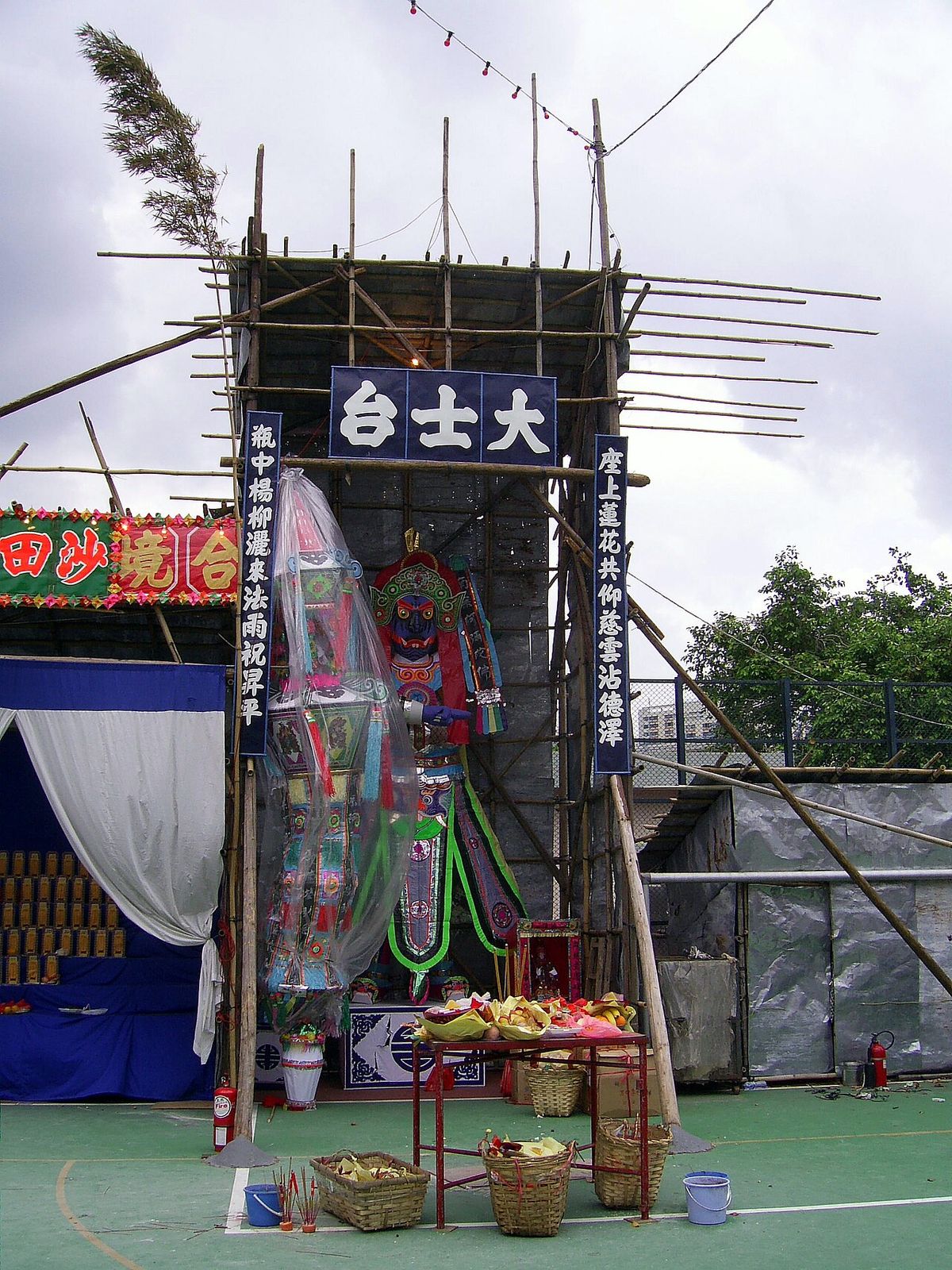
The Hungry Ghost Festival (Yu Lan Jie, 盂蘭節), observed across Chinese cultures during the seventh lunar month each year (generally July–August), is considered by Taoist, Buddhist, and folk-Chinese practitioners alike to be the period when the gates of Diyu — the Chinese underworld — are opened and the restless and unpropitiated dead return to the world of the living for thirty days. Hong Kong's observance of the festival, maintained with particular intensity by the Chiu Chow (Teochew) community, is regarded as one of the most spiritually-active paranormal periods in the Chinese world. Street-corner incense burns continuously. Paper offerings — including life-size paper 'ghost money' (hell bank notes), paper houses, paper cars, and paper smartphones — are folded and burned for the benefit of wandering spirits.
The festival centers on ritual opera performances — especially Teochew and Cantonese opera — staged outdoors on temporary bamboo structures in which the first row of seats is always left empty for the spirits. Food offerings are laid on pavements and roundabouts. Swimming is traditionally avoided during the entire seventh lunar month because of belief that drowned ghosts seek substitutes to take their place. Paranormal reports during the festival period consistently spike: Hong Kong's public hospitals have historically noted increased mental-health admissions during the seventh lunar month, and the Hong Kong Police have a documented practice of increased patrol in districts with strong festival activity.
The festival's scale in Hong Kong is extraordinary: UNESCO added the Hong Kong Chiu Chow community's Yu Lan Festival to its Representative List of the Intangible Cultural Heritage of Humanity in 2011. Ritual practitioners at the Po Lin Monastery on Lantau Island, the Wong Tai Sin Temple, and the Man Mo Temple in Central maintain formal records of festival-related paranormal phenomena. The Hungry Ghost Festival represents perhaps the most continuously-practiced, population-scale spiritual observance in the developed world — an entire city's deliberate engagement with the presence of the dead for a month each year.