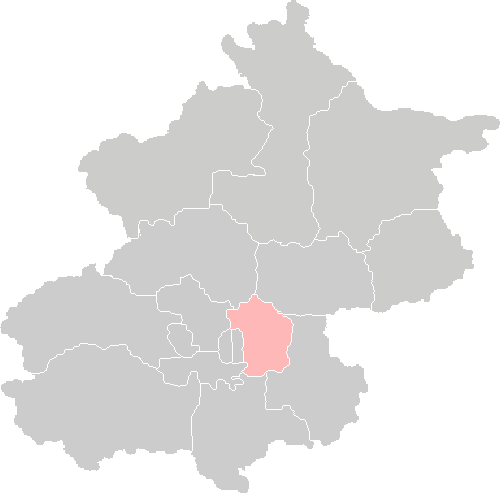
On the evening of July 9, 2010 — two days after the Hangzhou Xiaoshan Airport UFO incident — residents of the Chaoyang District of Beijing reported a similar glowing unidentified object hovering over the Chaoyang Gymnasium and the nearby Sanlitun nightlife district. The event began at approximately 9:30 PM and continued for roughly 40 minutes. Multiple witnesses reported the object as an elongated metallic-grey mass with a pulsing row of lights along its underside; photographs and mobile-phone video were captured by dozens of pedestrians and published on Sina Weibo within hours, generating more than 18 million views the first night.
China's Civil Aviation Administration and the Beijing Air Traffic Control Centre confirmed receiving radar contact for the object, which was subsequently tracked moving slowly south-southwest across the city. Beijing Capital International Airport briefly halted departing traffic during the duration of the sighting. The People's Liberation Army Air Force's 15th Airborne Corps, the nearest military command, denied any operational activity over central Beijing. Astronomers at the Beijing Planetarium and the Purple Mountain Observatory also denied any correlation with astronomical phenomena. The Chaoyang District People's Government issued a formal statement on July 11 noting that the object's origin 'could not be immediately identified.'
The Chaoyang UFO is significant as the second of three major 2010 Chinese airspace incidents — Hangzhou on July 7, Chaoyang on July 9, and Chongqing on September 11 — that collectively drew unprecedented official acknowledgement in a country that has historically been reluctant to discuss UFO phenomena. Prominent Chinese UFO researcher Sun Shili, former translator for Mao Zedong and founding member of the Beijing UFO Research Society, cited the 2010 incidents as the most significant evidence of organized extraterrestrial presence in Chinese history. The photographs and ATC records remain publicly available, and the incident is routinely cited alongside Hangzhou as foundational to modern Chinese UFO research.