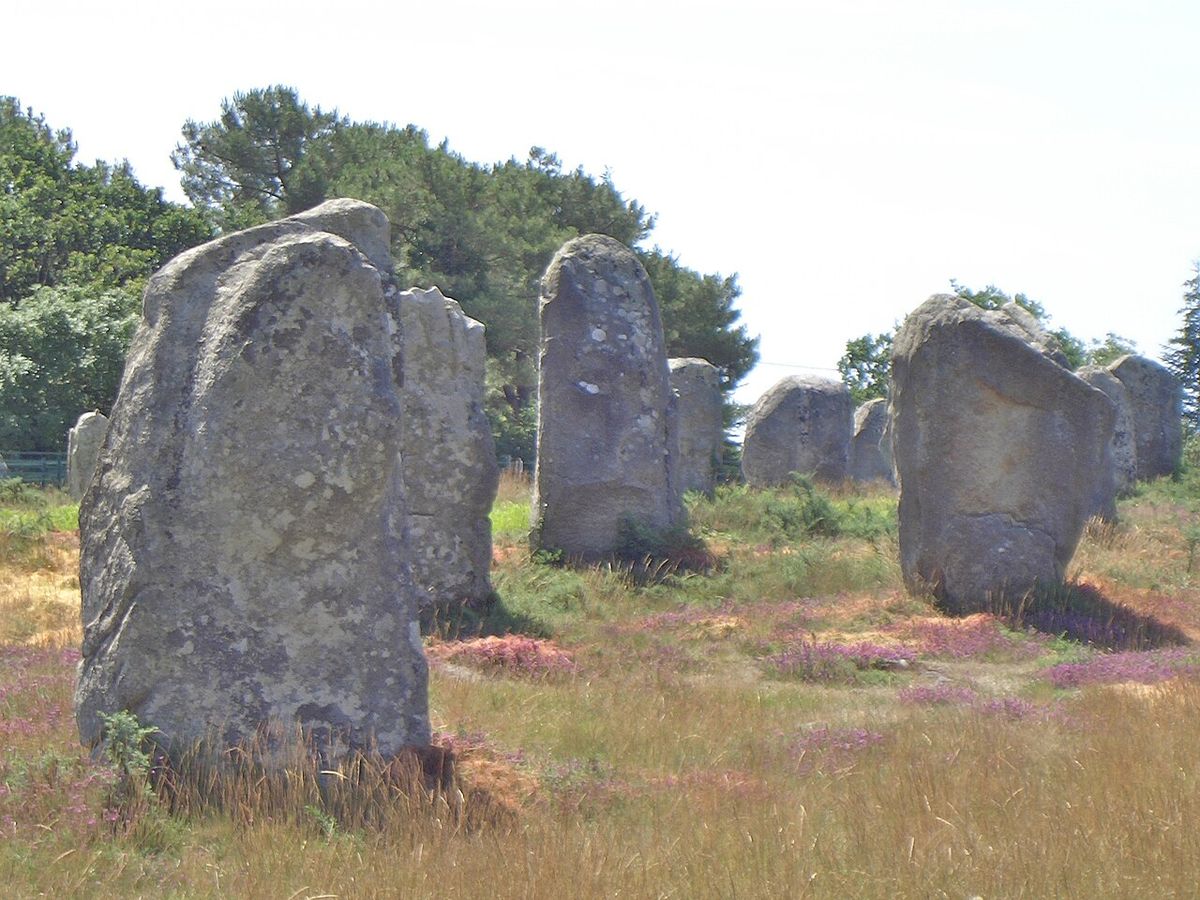
The Carnac stones, located in southern Brittany in northwestern France, comprise the densest concentration of Neolithic standing stones anywhere in the world — more than 3,000 menhirs arranged over nearly four kilometres of coastal heath in precisely-aligned rows, dolmens, tumuli, and stone circles. Constructed between approximately 4,500 and 3,300 BCE by the pre-Celtic inhabitants of Brittany, the site pre-dates Stonehenge, the Giza pyramids, and the Mesopotamian ziggurats. The stones' alignments have been variously interpreted as astronomical calendars, ancestral memorials, landscape-ritual pathways, and — in the most speculative interpretations — as markers of planetary geomagnetic anomalies.
Breton folklore attributes the stones to the flight of a Roman legion turned to stone by Saint Cornelius in the third century CE; earlier Celtic traditions describe them as petrified giants or as 'crocks' or 'goblins' (lutins) who failed to hide before sunrise. More distinctively, Breton oral tradition holds that the stones move at Christmas Eve midnight to bathe collectively in the nearby Étel River, returning to their positions before dawn. Those who observe the movement are said to be crushed by the returning stones; hikers and researchers who camp near the alignments at Christmas have on numerous occasions reported hearing 'grinding sounds' and shifting shapes in the darkness, though no photographic evidence has ever been produced.
Contemporary paranormal reports at Carnac concentrate on electromagnetic anomalies (strong enough to disrupt GPS and compass readings in specific areas of the Le Ménec alignment), reports of 'cold spots' near particular large menhirs, and occasional photographic orbs — which skeptics attribute to the high humidity and dust loads of the Breton coast, and believers interpret as residual-consciousness phenomena. French researcher and megalith expert Jean-Pierre Mohen has catalogued the site's anomalies in detailed studies. The Carnac alignments represent Europe's most significant prehistoric site of continuous paranormal-cultural tradition, and — with the Côte des Mégalithes more broadly — are central to the folklore and contemporary paranormal landscape of Brittany.